
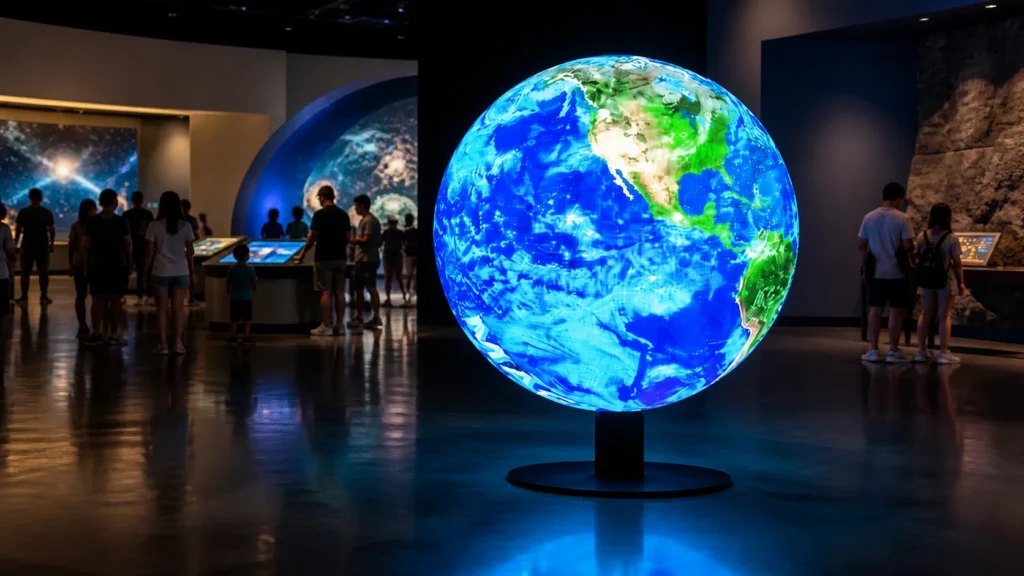
An LED sphere turns moving content into a 360-degree visual object. It can become a landmark in a museum, science center, corporate atrium, exhibition or themed venue, but the curved geometry makes planning different from a conventional flat LED wall.
A successful specification must connect diameter, pixel pitch, resolution, installation structure, service access and content production. The following checklist helps project owners, designers and integrators define the information a manufacturer needs before engineering begins.
1. Match the sphere diameter to the space
Start with the available room volume, intended viewing distance and the visual role of the display. A sphere used as a close-view educational exhibit requires a different scale from a suspended landmark in a large atrium. JIAMI TV’s standard planning range includes diameters of 1.0, 1.5, 2.0 and 2.5 meters, with project-specific evaluation available where the structure and module geometry permit.
Record the clear height, floor area, door and elevator dimensions, ceiling structure and any nearby walls, lighting or visitor circulation. The installation drawing should show both the final sphere envelope and the space required for assembly, lifting and maintenance.
2. Select pixel pitch from viewing distance and content
The current standard configurations include P1.8 and P2.5. A smaller pixel pitch increases pixel density and can improve close-view detail, but it also affects cost, power density, control load and module design. The correct choice depends on how close visitors will stand, whether the sphere will display fine text or detailed data, and how much of the surface is visible at one time.
For P2.5 configurations, published resolutions progress from 1256 × 628 pixels at 1.0 meter diameter to 3141 × 1570 pixels at 2.5 meters. P1.8 configurations range from 1675 × 837 to 4188 × 2094 pixels across the same standard diameters. These values describe the complete mapped canvas and should be confirmed in the final technical proposal.
3. Understand the custom-shaped module system
A sphere cannot be assembled from identical flat rectangles without visible steps or large seams. The system uses custom A, B and C shaped LED modules that combine into the curved surface. Module geometry, frame tolerance and seam alignment determine whether the sphere reads as one continuous visual object.
Ask for an engineering drawing that identifies module types, segmentation, cabinet or frame structure, cable routes and service sequence. Prototype verification is especially valuable when a project changes the standard diameter, support method or surrounding architectural finish.
4. Choose the installation method early
Common installation methods include a floor base, suspension or a fixed supporting structure. A floor-mounted sphere is straightforward to position and can make service access easier, but the base must suit the venue’s appearance and stability requirements. A suspended sphere creates a strong floating effect, while introducing ceiling-load, rigging, access and safety coordination.
A fixed structure may be integrated into an exhibit, stage set or architectural feature. In every case, a qualified structural engineer should confirm loads, anchoring, local safety factors and building interfaces. The manufacturer’s product drawing should be coordinated with the venue’s approved structural design.
5. Plan service access and environmental conditions
The published product configuration uses front service with an IP45 protection reference. Front service allows modules to be accessed from the visible surface, which is helpful where the rear of the sphere is enclosed. The surrounding design still needs sufficient working space and a safe method for reaching upper modules.
The listed operating range is -20 to 60 °C and 10–85% relative humidity, but project conditions must be reviewed individually. Indoor atriums, exhibition halls and museums can have localized heat, dust, direct sunlight or restricted airflow. Confirm ventilation, operating hours, cleaning procedures and access equipment before final approval.
6. Coordinate brightness, refresh rate and cameras
Published brightness is approximately 700 cd/m² for P2.5 and 600–700 cd/m² for P1.8, with a 3840 Hz refresh rate. The high refresh rate supports camera-conscious environments, but filming performance also depends on brightness, scan behavior, shutter speed and exposure.
Test representative content with the venue’s lighting and camera equipment. In a museum or dark immersive room, comfortable low-brightness performance may be more important than maximum output. In a bright atrium, reflections and direct daylight should be assessed before selecting the operating level.
7. Produce content for a spherical canvas
Flat artwork cannot simply be stretched onto a sphere without distortion. Content must be mapped to the complete spherical resolution and reviewed from multiple viewing angles. Important logos and text should not cross high-distortion areas or disappear behind the object from the main audience position.
Ask the content producer to work with the manufacturer’s UV map, pixel map or playback template. Create short tests for the equator, poles and seams, then validate them on the assembled display. Slow motion, global data, astronomy, brand animation and abstract patterns often work well because they use the sphere as a complete form rather than a flat billboard.
Information to include in a project inquiry
- Target diameter and preferred pixel pitch
- Venue drawings, clear height and access dimensions
- Floor-mounted, suspended or fixed installation preference
- Nearest and typical viewing distances
- Content type and required native canvas
- Camera, recording or live-streaming requirements
- Daily operating hours and environmental conditions
- Delivery schedule, installation location and support requirements
With these inputs, the manufacturer can review module geometry, resolution, frame structure, control load, power, access and packing. Visit the JIAMI TV LED Sphere Display page for the current product range, or send the project drawings for an engineering review.
Published figures are selection guidance. Final structural, electrical, environmental and compliance requirements must be confirmed for the approved project configuration and installation location.